New rules bring permits, registered leases and inspections to shared accommodation, with fines reaching AED 1 million for repeat violations
Dubai shared housing law: Renting out a spare room, sharing an apartment with other residents or advertising accommodation online may seem like straightforward arrangements. Under Dubai’s new shared housing regime, however, they can have significant legal consequences.
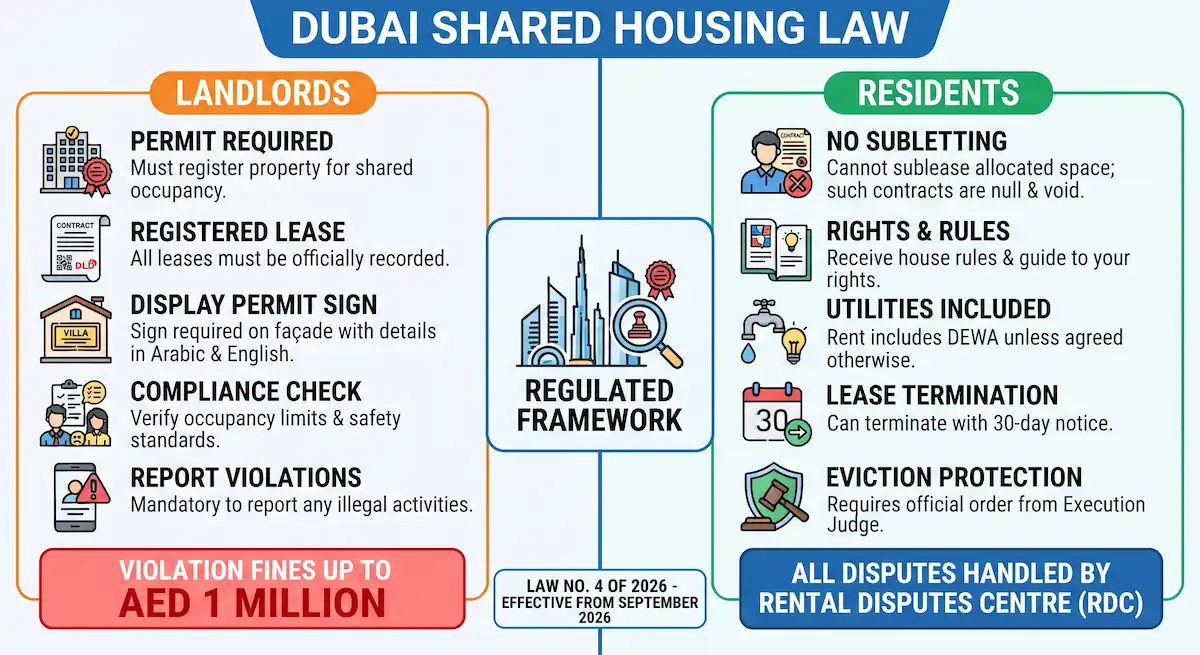
Dubai Law No. 4 of 2026 on the Regulation of Occupancy and Management of Shared Housing introduces a comprehensive framework governing how shared accommodation is permitted, leased, managed, occupied, advertised and inspected.
The Dubai shared housing law is aimed at tackling overcrowding and unregulated accommodation while improving public health, safety and security and protecting the rights of owners and occupants. It also seeks to promote fairness in the shared-housing rental market and preserve the emirate’s urban environment. These objectives are expressly set out in Article 4.
And the consequences of getting it wrong are substantial.
Violations can attract fines ranging from AED 500 to AED 500,000. Where the same violation is repeated within one year, the fine may be doubled, subject to a maximum of AED 1 million. The specific violations and corresponding penalties are to be prescribed by decision of the Chairman of the Executive Council.
If the same violation occurs again within one year, the fine is doubled, although it cannot exceed AED 1 million.
Authorities may impose a range of administrative penalties for violations, including:
- Suspension from practicing the activity for up to six months;
- Revocation of the permit;
- Coordination with the Licensing Authority to revoke the establishment’s commercial licence;
- Suspension of public services to the violating unit until the violation is remedied;
- Refusal to process any transactions related to the violating property;
- Withholding building permits until the violation is rectified;
- Seizure of equipment or devices used in the violation like partition, beds etc.;
- Refusal to register lease or management contracts for the violating units until compliance;
- Evacuation of the property by order of the Execution Judge if permit requirements are violated.
These administrative penalties are in addition to fines and do not preclude civil or criminal liability.
What counts as shared housing?
The Dubai shared housing law casts a relatively wide net.
Shared housing is defined as shared occupancy by a group of individuals or families where each is allocated a space within a property for residential purposes and facilities or services — such as the kitchen, dining room, bathroom or outdoor areas — are shared. This distinction is important. The legislation is not confined to what might colloquially be described as overcrowded “bed-space” accommodation. It creates a wider regulatory framework for qualifying shared occupation.
The Law applies to real estate units throughout Dubai, including those in special development zones and free zones. Collective labour accommodation, however, is expressly excluded.
Can you simply rent out a spare room?
Not without considering the new regulatory requirements.
Article 8 provides that no individual or legal person may allocate a property for shared housing without obtaining a permit.
Permits are generally valid for one year and renewable for similar periods. At an owner’s request, the competent authority may set the permit period at two years. Renewal applications must be submitted at least 30 days before expiry.
Approval also depends upon the property satisfying applicable requirements, including occupancy limits, the amount of space allocated to individual occupants and the facilities and services provided.
Can a tenant sublet a room or bed space?
For occupants, this is one of the clearest restrictions under the Dubai shared housing law.
The right to lease a property designated for shared housing is limited to the owner and an authorised establishment. An occupant or third party cannot sublease the unit or the space allocated to the occupant.
Article 26 goes further: an occupant must not sublease his or her allocated space, and a lease entered into by an occupant in breach of that restriction is deemed null and void.
But that should not be misunderstood as a prohibition on every form of subleasing. An authorised establishment may lease the entire property from an owner for the purpose of subleasing it to occupants. Alternatively, it may manage and lease the property on the owner’s behalf under a management contract.
The crucial issue, therefore, is who is doing the subletting and whether that person or establishment is authorised to do so.
“Only the owner or an authorised establishment can lease or sublease a shared housing unit. Occupants cannot sublease their allocated space—any such contract is null and void.”
Families, students, men and women: Who can use shared housing?
The Law identifies several categories.
They include families, individual women, individual men, male and female students, employees of government entities, and workers of companies and private institutions.
Permitted properties may include apartments, standalone houses, residential complexes, mixed-use buildings, adjoining houses and multi-storey buildings.
However, the categories and permitted property types may subsequently be amended through decisions issued under the Law.
How many people can live in one apartment?
The Dubai shared housing law does not impose one universal numerical occupancy limit for every property.
Instead, Dubai Municipality is empowered to determine the maximum number of occupants permitted in each unit, the space allocated to each occupant and the shared services and facilities that must be provided. In setting broader standards, the Municipality may consider matters including urban planning, population density, infrastructure, sewage systems and the social characteristics of residential neighbourhoods.
Properties must also comply with planning and construction requirements as well as public-health, fire-safety, sanitary, environmental, security and electricity-network safety standards.
This means a landlord should not assume that the physical ability to fit additional beds into a property determines its lawful occupancy.
Your shared-housing lease will enter a formal register
A significant feature of the new regime is the Shared Housing Register, maintained by the Dubai Land Department.
Management contracts and their amendments, lease contracts and their amendments, occupants’ data and other prescribed information are to be recorded in the Register. For lease contracts, registration has particular legal significance.
A lease and any amendment must be recorded to be effective. An unregistered lease is not recognised, and the owner or establishment cannot exercise rights under it until registration.
There is, however, an important protection for residents: failure to register does not affect a bona fide occupant’s ability to enforce the lease against the owner or establishment.
Landlords have more responsibilities than collecting rent.
The Dubai shared housing law imposes an extensive set of duties on lessors.
Among other things, they must comply with the occupancy limit in the permit, register the lease, maintain the property, carry out emergency repairs, maintain technical compliance documentation and provide the basic requirements necessary for residence.
According to article 25, a sign must be displayed conspicuously on the property’s façade showing the permit holder’s details in both Arabic and English and identifying the category of shared housing.
Residents must also receive house rules and a multilingual guide explaining their rights and obligations, emergency contact numbers and permitted uses of the property.
There is another duty landlords should not overlook: lessors must verify occupants’ compliance and promptly report observed violations. The Law expressly states that failure to report such violations constitutes an offence giving rise to liability.
Residents also have rules to follow.
The responsibilities do not fall on landlords alone.
Occupants must comply with environmental, health and public-safety requirements and exercise reasonable care in looking after the property.
They cannot use their allocated space for anything other than residence, allow others to reside in or benefit from it, carry on economic activities from the property or sublease their space.
They must also allow the lessor to enter to verify continued compliance with the statutory requirements.
Does rent include electricity and water?
Unless the parties agree otherwise, yes.
The Law provides that rent is payable monthly in advance unless another arrangement is agreed. Electricity and water consumption charges are included in the rent unless the parties agree otherwise, although responsibility for paying those charges to the service provider rests with the lessor.
Article 19(b): “The rent shall include the charges for electricity and water consumption, unless the parties agree otherwise, provided that the lessor bears the cost of paying these charges to the entity responsible for providing the service.”
For residents comparing advertised room prices, that provision could become particularly relevant.
Can a resident terminate the lease?
A resident (occupant) can terminate the lease during its term, subject to the notice requirements in Article 20 of Dubai Law No. 4 of 2026.
- Notice Requirement: The occupant may terminate the lease at any time during its term, but must notify the lessor at least 30 days before the expiry of the contract, or as stated in the lease contract, whichever is longer.
- Refund of Advance Rent: After termination, the occupant may request a refund of any rent paid in advance, less one month’s rent.
- Claim for refund: If the refund is not received within 30 days of the request, the occupant can petition the Execution Judge to claim the refund.
- Right to occupy: The occupant retains the right to remain in the unit until the end of the notice period or as specified in the contract. Thus, selling the property does not automatically end the resident’s lease. The occupant retains the right to remain under the terms of the existing contract.
When can a landlord ask an occupant to leave?
The Law specifies circumstances in which a lessor may seek evacuation before the lease expires.
These include failure to pay rent within 30 days after notification, unlawful use, revocation of the permit, structural danger, demolition or certain necessary building works.
An owner may also seek the property for personal use or for a first-degree relative, subject to the applicable notice requirement.
Eviction is not simply a matter of changing the locks. The lessor must submit a petition to the Execution Judge to obtain an eviction order (Article 24).
Execution of an eviction order is suspended while a grievance is being considered, provided the grievance is filed within 7 days from the date the eviction decision is notified to the concerned party.
Advertising rooms online? Check the advert too
The Dubai shared housing law reaches beyond the property itself and into its marketing. Printed and digital promotional material relating to shared housing must contain the establishment’s registered trade name and permit number.
Owners and establishments must not misleadingly showcase, describe or advertise shared accommodation, promote it for an unauthorised purpose or advertise contrary to the Law and its implementing decisions.
Authorities can inspect shared accommodation
Inspection is an integral part of the new system.
The competent authority is empowered to conduct inspections, monitoring and periodic field visits to determine whether properties and the people responsible for them are complying with the Law. Owners, establishments and occupants must allow authorised enforcement personnel to enter shared-housing properties for these purposes.
The Law also provides for a permanent Committee for the Supervision of Shared Housing in Dubai. Its functions include inspection programmes based on reasonable evidence or documented complaints and periodic and sudden inspection campaigns, while expressly recognising approved legal procedures and the inviolability of private residences.
Where will disputes go?
The Rental Disputes Centre has exclusive jurisdiction to hear and determine disputes concerning rights and obligations arising under the Law and its implementing decisions.
There are two separate procedures under Dubai Law No. 4 of 2026.
Evacuation (Eviction) Decisions: If an occupant is ordered to vacate, they may file a grievance against the Execution Judge’s decision within 7 days of notification. Execution of the eviction is stayed while the grievance is determined (Article 24).
General Grievance Procedure: For other administrative decisions, actions, or measures under the law, any interested person may file a written grievance within 30 days of notification. The grievance is decided within 30 days by a committee formed by the competent entity (Article 35).
Dispute Resolution: The Rental Disputes Centre has exclusive jurisdiction to hear and determine disputes concerning rights and obligations under the law and its implementing decisions (Article 36).
What happens to existing shared housing?
Existing arrangements are not ignored.
Owners who had already allocated properties for shared housing and establishments already conducting the regulated activity before the Law entered into force must regularise their position within one year from its effective date. The Director-General may extend that period once if necessary.
When does the Dubai shared housing law take effect?
This point requires particular care.
The Law itself was issued on 27 February 2026. Article 40 states that it comes into force 180 days from the date of its publication. The English Lexis Middle East text supplied for this article records publication in Official Gazette Issue No. 764 (Private), dated 12 March 2026.
The draft supplied for review calculates this as 08 September 2026. Given the significance of the commencement date to transitional obligations, the effective date should be verified against the official regulatory position and any implementing decisions before publication rather than inferred solely from the translated publication note.
From informal sharing to regulated housing
Dubai’s population is diverse, mobile and growing. Shared accommodation is consequently a practical reality for many professionals, workers, students and families.
The Dubai shared housing law does not simply prohibit people from sharing homes. What it does is move qualifying shared accommodation towards a formal regulatory structure built around permits, authorised operators, registered leases, identified occupants, occupancy controls, safety requirements, inspections and enforcement.
For owners, operators and residents, that changes the question they need to ask.
It is no longer merely: “Can I rent this room?”
It is also: “Can this room legally be rented in this way?”
“A shared home may begin with a simple agreement over a room and the rent, but the new law makes clear that informal arrangements can carry formal legal responsibilities.”
THIS ARTICLE IS FOR GENERAL INFORMATION ONLY AND DOES NOT CONSTITUTE LEGAL ADVICE. LEGAL ADVICE SHOULD BE OBTAINED ON THE APPLICATION OF DUBAI LAW NO. 4 OF 2026 TO PARTICULAR CIRCUMSTANCES.
Author’s Bio:
Nikhat Sardar Khan (FCIArb)(RICS)
LinkedIn: https://www.linkedin.com/in/nikhatskhan
Nikhat Sardar Khan (FCIArb) (RICS) is a Dubai-based legal practitioner with more than three decades of professional experience. She is an accredited mediator and arbitrator and a DIFC Courts Part I and II Practitioner with Full Rights of Audience.
Legal insight @ Legal Services Dubai.